Caving
The Cave Kept the Daylight
Six hours underground, daylight stopped feeling ordinary. It became a direction, a promise, and eventually a thin blue shape ahead of us.
01
The last patch of sky
The cave entrance sat behind a curtain of vines and looked smaller than the river coming out of it. Mara, our guide, checked the upstream forecast once more, wrote our entry time in a book at the ranger post, and asked each of us to show both a main light and a backup. She had already checked them. This was not theatre; repetition is how serious people keep small failures small.
Inside, the afternoon disappeared in less than twenty steps. The air cooled, conversation shortened, and the sound of the river grew until it occupied the whole passage. I looked back once. The entrance had become a bright green coin behind us. Then the tunnel bent and daylight was gone.
02
A world the beam invented
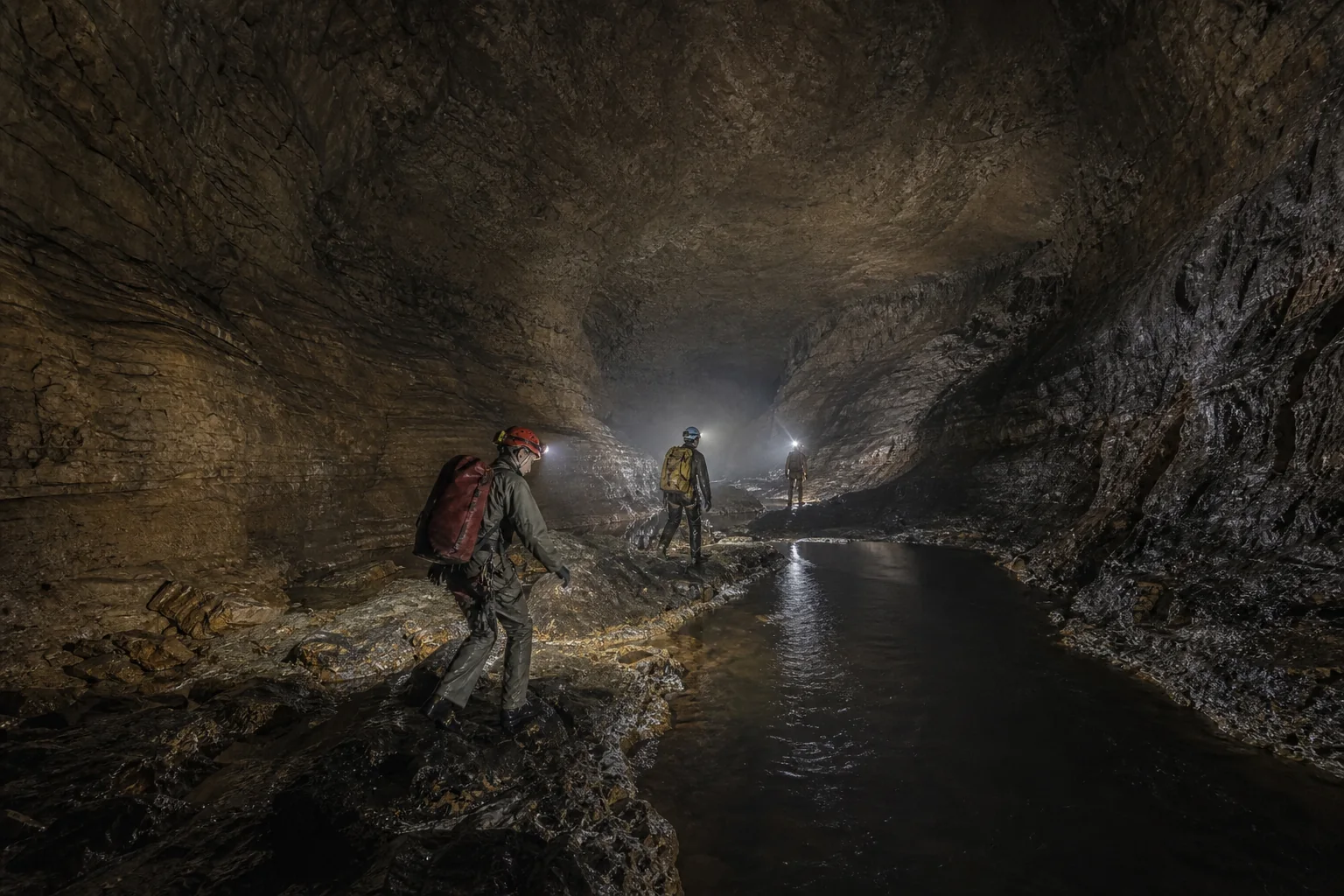
A headlamp gives you a private version of a cave. Mine contained wet stone, Mara's boots, and the next two metres. Everything beyond the beam might have been a wall or a chamber large enough to hold a building. When we crossed the river, we faced upstream and moved one foot at a time, keeping three points of contact while black water pushed against our shins.
At a narrow ledge, a fixed handline ran above the current. Mara crossed first, then watched every buckle and foot placement. Nobody hurried. Underground, impatience looked less like confidence and more like extra weight the group would have to carry. We clipped past the anchor one at a time and regrouped where the passage widened.
“In complete darkness, courage is not moving faster. It is knowing exactly what the next safe movement is.”
03
When one light failed
My lamp began flickering in the largest chamber. There was no drama: I stopped, said 'light,' and the person behind me placed a hand on my shoulder while I switched to the backup clipped inside my helmet. The whole thing took perhaps fifteen seconds. Still, those seconds changed the cave. Until then the darkness had been scenery. Suddenly it was the default condition, held back by equipment we had been sensible enough to duplicate.
Farther in, Mara asked us to sit on a shelf above the river and turn every lamp off. The dark was not like night. Night has edges, stars, distant windows. This had nothing to focus on and no scale. We could hear water travelling through rock and each other breathing. After a minute, someone laughed quietly. The sound felt enormous.
04
The colour blue
We turned around at the planned time, not at a landmark. On the return, the route felt familiar until it did not; passages seen from the other direction rearranged themselves. Mara's decisions, the survey in her pocket, and the small reflective markers mattered more than memory. We crossed the river again, unclipped the ledge, and counted the group at every junction.
The first sign of the outside was not light but warmer air. Then a faint blue shape appeared around a bend. By the time we stepped through the vines, rain was tapping the leaves and evening had settled over the valley. Nothing outside had changed. That was the strange part. The sky, wind, mud, and ordinary distance between trees all felt newly generous. The cave had not made the world smaller. It had returned depth to things I had stopped noticing.